
The Pelvic Reset: How to Use 5-4-3-2-1 Grounding to De-Escalate Anxiety and Pelvic Pain
Feb 20, 2026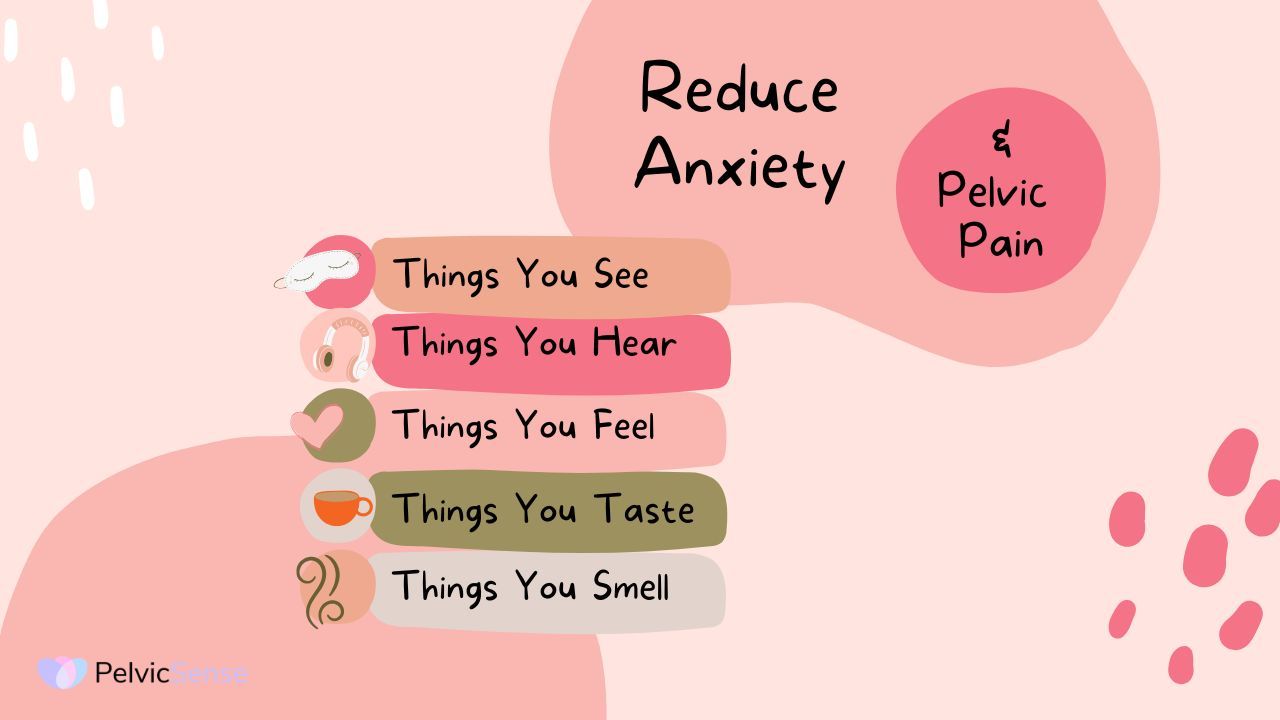
Key Takeaway:
- The Brain-Pelvis Link: The pelvic floor works like a physical barometer for emotional stress, which can cause it to tighten up without you realizing.
- Pain Science Education (PSE): Learning that pain is a signal meant to protect you, not just a sign of damage, is the first step toward recovery.
- The 5-4-3-2-1 Tool: This sensory exercise helps move your body from a stressed state to a calmer, more relaxed one.
- Evidence-Based: Research indicates that managing the nervous system is as critical as physical exercise for resolving pelvic floor dysfunction.
Introduction: Why Your Pelvis Feels Stuck
If you have ever felt a dull ache in your pelvis during a stressful work week, or noticed that your pelvic pain flares up right when your anxiety spikes, you aren't imagining it. For decades, pelvic health was treated as a purely mechanical issue a matter of weak or tight muscles. However, modern pain science has revealed a much more complex and fascinating truth: the pelvic floor is one of the most emotionally responsive muscle groups in the human body.
When you feel anxious, your brain triggers a physical response throughout your body. This automatically shows up in the pelvic floor area first. In this blog, you’ll learn why this happens and get a simple tool, the 5-4-3-2-1 grounding technique, to help your body relax and release tension.
What is 5-4-3-2-1 Grounding?
The 5-4-3-2-1 grounding technique is a mindfulness exercise that uses your five senses to bring your attention back to the present moment. When you’re anxious, your mind can get stuck on racing thoughts, a pounding heart, or pain.
Grounding works from the body up. Instead of trying to think your way out of anxiety, which can be tough during a flare, you use your five senses to give your brain calm, neutral information. By noticing what you can see, feel, hear, smell, and taste, you help your brain receive safety messages, which lets your pelvic floor muscles release.
Why are grounding techniques helpful?

To see why grounding helps the pelvic floor, it’s important to know about the Autonomic Nervous System (ANS). The ANS has two main parts:
- The Sympathetic Nervous System (SNS): Your accelerator. It prepares you for battle or flight.
- The Parasympathetic Nervous System (PNS): Your brake. It’s responsible for rest, digestion, elimination and sexual function.
The pelvic floor is strongly affected by the SNS. When you’re stressed, the SNS causes your muscles to tighten as a protective reflex. In the past, this helped protect us from danger. Today, stress from things like a busy inbox or tough relationships can trigger the same reaction, making your pelvic floor clench.
A major study in Ginekologia Polska found that more than 60% of people with chronic pelvic pain also have clinical anxiety. Grounding acts as an off-switch for this stress response. It helps you return to a calmer state, so your pelvic floor can soften.
Understanding the 5-4-3-2-1 Grounding Technique
This technique should be done slowly. The aim is not just to go through the motions, but to take a moment to notice, focus on each sensation.
Identify 5 Things You Can See:
Notice details you usually overlook. Try to be specific about what you see.
Example: I see the specific way the sunlight reflects off my coffee cup. I see a small scuff mark on the baseboard. I see the texture of the carpet fibers. I see the green hue of a leaf on my plant. I see a blue pen on the table.
Identify 4 Things You Can Feel:
Pay attention to the edges of your body. This helps you sense where your body is in space, which is called proprioception.
Example: I feel the weight of my sit-bones pressing into the chair. I feel the soft cotton of my shirt against my shoulders. I feel the cool air on the tip of my nose. I feel the slight tension in my jaw (and I choose to let it go).
Identify 3 Things You Can Hear:
Try to notice different sounds, both near and far.
Example: I hear the distant hum of traffic outside. I hear the gentle whir of the refrigerator. I hear the sound of my own breath as it enters and leaves my lungs.
Identify 2 Things You Can Smell:
Smell connects directly to the part of your brain that handles emotions. processes emotion.
Example: I smell the faint scent of the lavender candle I lit earlier. I smell the fresh, crisp scent of the air coming through the cracked window.
Identify 1 Thing You Can Taste:
This could be a taste that’s still in your mouth or a slow, mindful sip of water.
Example: I taste the herbal notes of the peppermint tea I just drank.
How to Do the 5-4-3-2-1 Grounding Technique
To get the most out of this for your pelvic health, try adding a body-scan step to the usual method:
- Posture Check: Sit with your feet flat on the floor. Avoid crossing your legs, as this can increase pelvic floor tension.
- The Pelvic Drop: Before you begin, take a deep breath into your belly. Picture your pelvic floor gently widening, expanding like the way water ripples outward when a pebble is dropped into a still pond.
- The Countdown: Work through the 5-4-3-2-1 steps outlined above.
- Integration: After each sense, check in with yourself and ask, Am I still clenching? or How does my pelvic floor feel? Notice the sensation in your pelvis without judgement. Then move on to the next sense.
- Closing: Finish with three deep breaths, feeling your ribs, belly, and back all expand together.
How the 5-4-3-2-1 Technique Works: A Deep Dive into Pain Science
The relationship between anxiety and pain is governed by several neurological principles. Understanding these rules of the brain can help you feel more in control of your symptoms
Promotes Sensory Awareness (Breaking Hyper-Vigilance)
When we are in pain, we often develop hyper-vigilance. We are constantly scanning our pelvis for the slightest twinge of discomfort. This internal scanning actually trains the brain to perceive more danger, which results in the brain sending pain and pelvic muscle tension. By focusing on 5 things you can see or 3 things you can hear, you are giving your brain a break from this exhausting internal surveillance.
Activates Neural Pathways (The Prefrontal Takeover)
Anxiety comes from the older part of your brain, called the limbic system. The 5-4-3-2-1 technique makes you think, count, and name things, which uses the prefrontal cortex, the executive part of your brain. When this part is active, it helps calm down the area that causes panic.
Interrupts the Anxiety Loop (The Bio-Psycho-Social Model)
Pain science uses the Bio-Psycho-Social model, which suggests that pain is influenced by biological factors (tissues), psychological factors (stress/beliefs), and social factors (environment). Anxiety is a Psychological factor that has a Biological consequence: muscle guarding. Interrupting the anxiety loop with grounding prevents the psychological stress from manifesting as a physical pelvic spasm.
Relaxes the Body (The Diaphragm-Pelvic Floor Piston)
The pelvic floor and your breathing muscle, the diaphragm, work together. When you’re anxious, you may tend to use the secondary accessory muscles of the neck and shoulders to breathe. This breathing action signals your brain that there’s danger and keeps your pelvic floor tense. Grounding helps slow your heart rate and allows your diaphragm to move lower, which relaxes and softens your pelvic floor. Research in the Journal of Inflammation Research shows grounding can lower muscle tension and improve heart rate variability, a key sign of a healthy, relaxed nervous system.
Benefits of the 5-4-3-2-1 Grounding Technique
- Down-regulates the Nervous System: Moves you from High Alert to Safety.
- Reduces Nervous System Sensitivity: As noted in Frontiers in Cellular Neuroscience, chronic pain can make your nervous system overly sensitive through a process called central sensitization, leading to an overprotective brain that sends pelvic pain and muscle guarding to the pelvis. Grounding helps calm these pathways.
- Improved Pelvic Awareness: It teaches you to differentiate between a clenched state and a relaxed state. Many find that utilizing the PelvicSense Program alongside these exercises offers the education needed to fully master this mind-body awareness.
- No Equipment Needed: You can use this technique anywhere during a pelvic exam, intimacy, or even while shopping.
Tips for Practicing the 5-4-3-2-1 Grounding Technique
- The 10% Rule: Don’t expect to relax completely right away. Just aim to feel a little more relaxed than before about 10% is enough.
- The Jaw-Pelvis Connection: Your jaw and pelvis are linked in your body and brain. While grounding, keep your teeth slightly apart and your tongue away from the roof of your mouth. When your jaw relaxes, your pelvis often does too.
- Environment Matters: If you’re at home, try grounding while sitting on a yoga cushion or a warm heating pad. This can help your pelvic area feel even safer.
- Educational Support: Utilizing resources like PelvicSense can help you understand the why behind your symptoms, which is a proven way to lower the brain's threat response.
FAQs
What is the 3-3-3 rule for anxiety?
The 3-3-3 rule is a simplified version of grounding: name 3 things you see, 3 sounds you hear, and move 3 parts of your body (e.g., circle your ankles, shrug your shoulders, wiggle your toes). It’s great for when you are short on time.
Why does the 5-4-3-2-1 coping technique work?
It works because the brain has limited"bandwidth. By flooding the brain with neutral sensory information (sight, sound, touch), there is less room for the brain to process anxious thoughts or amplify pain signals.
What is the 5-sense method?
It is simply another name for the 5-4-3-2-1 grounding technique, which uses all five senses to create a sensory anchor.
What is the 5-4-3-2-1 method?
It is the specific countdown method of mindfulness used to treat panic, anxiety, and dissociation (feeling disconnected from your body).
Can I use the 5-4-3-2-1 method in public for how to reduce anxiety?
Yes. In fact, it is one of the most popular tools for stealth anxiety management. You can do the entire process mentally without anyone noticing.
Conclusion: Your Path to a Calmer Pelvis
Healing pelvic pain is usually not about working harder, but about letting go of tension, no matter how tiny the release of tension feels. When you use the 5-4-3-2-1 grounding technique each day, you’re not just managing symptoms you’re helping your brain and body work together in a new way.
Research in The Journal of Urology suggests that your psychological state and your nervous system’s tone are the strongest predictors of whether pelvic therapy will be successful. Start treating your nervous system with the same care you treat your cherished family member, best friend, or your pet, and you may find that the tension in your pelvis finally begins to ease.
References
- Kalata, U., Jarkiewicz, M. M., & Barcz, E. M. (2023). Depression and anxiety in patients with pelvic floor disorders. Ginekologia Polska, 94(9).
https://journals.viamedica.pl/ginekologia_polska/article/view/90219 - Naliboff, B. D., Stephens, A. J., Afari, N., et al. (2015). Widespread psychosocial difficulties in men and women with urologic chronic pelvic pain syndromes: Case-control findings from the Multidisciplinary Approach to the Study of Chronic Pelvic Pain Research Network. Urology, 85(6), 1319-1327. https://pubmed.ncbi.nlm.nih.gov/26099876/
- Oschman, J. L., Chevalier, G., & Brown, R. (2015). The effects of grounding (earthing) on inflammation, the immune response, wound healing, and prevention and treatment of chronic inflammatory and autoimmune diseases. Journal of Inflammation Research, 8, 83-96. https://pubmed.ncbi.nlm.nih.gov/25848315
- Eller-Smith, O. C., Nicol, A. L., & Christianson, J. A. (2018). Potential mechanisms underlying centralized pain and emerging therapeutic interventions. Frontiers in Cellular Neuroscience, 12, 35. https://www.frontiersin.org/journals/cellular-neuroscience/articles/10.3389/fncel.2018.00035/full
Author
